

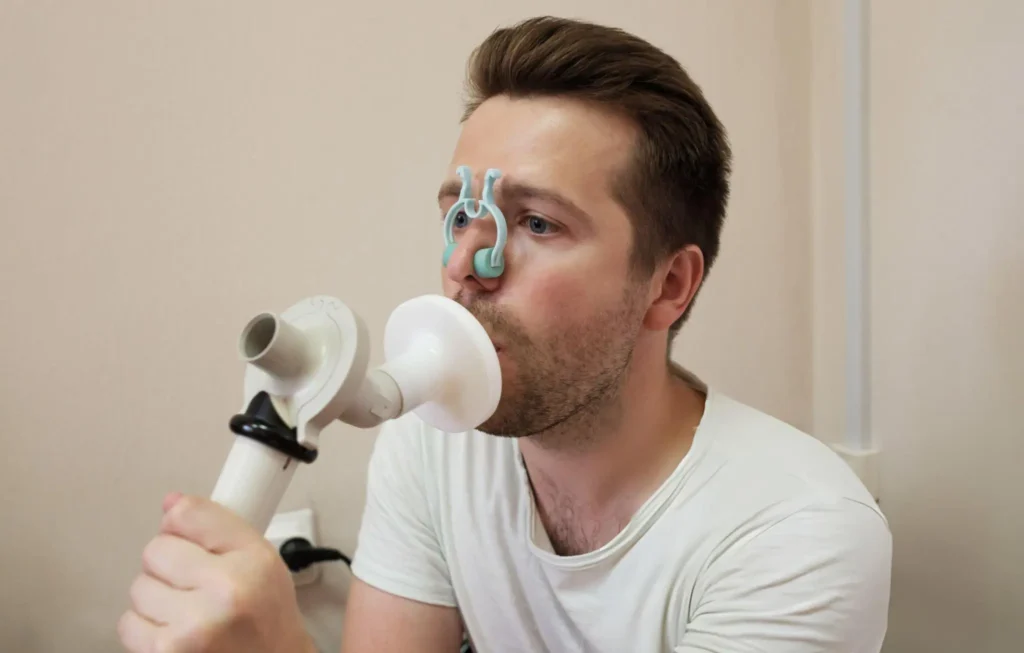
What Is a Spirometry Test? How It Works and What the Results Can Show
Spirometry is a lung-function test that measures how much air you can breathe out and how quickly you can expel it. A GP may recommend it when assessing symptoms such as persistent cough, wheezing or breathlessness, or when investigating conditions such as asthma or COPD.
Results provide useful information about airflow and lung function, but they need to be interpreted alongside your symptoms, medical history and clinical assessment rather than used for self-diagnosis.
Key Takeaways
- Spirometry measures airflow and the volume of air you can forcibly exhale.
- It may be used to investigate symptoms such as cough, wheeze and breathlessness.
- FEV1, FVC and the FEV1/FVC ratio are the key measurements.
- Some tests are repeated after a bronchodilator to compare results.
- Spirometry results should be interpreted alongside symptoms, medical history and clinical findings.
What Is a Spirometry Test and Why Is It Done?
A spirometer measures the volume and speed of air during forceful breathing. It does not involve needles or invasive instruments.
A GP may consider spirometry for three main reasons: investigating breathing symptoms, helping assess conditions such as asthma or COPD, or monitoring lung function in a person with an established respiratory condition. National Asthma Council Australia guidance supports spirometry as a useful tool in both the assessment and ongoing monitoring of asthma in primary care.
When Might a GP Recommend Spirometry?
A GP may discuss spirometry if you have any of the following:
- Persistent cough that keeps returning
- Wheezing during breathing or activity
- Breathlessness beyond what you would expect for your activity level
- Chest tightness without a clear explanation
- Reduced exercise tolerance
- Suspected asthma or possible COPD
- An existing respiratory condition that needs monitoring
Spirometry is not a substitute for urgent medical assessment. If you or someone else has severe difficulty breathing, seek urgent medical care and call 000 if the situation is serious or life-threatening.
If you have ongoing cough, wheezing or breathlessness, a general medical assessment can help determine whether spirometry or another form of assessment may be appropriate.
How Should You Prepare for a Spirometry Test?
Preparation can vary depending on the purpose of the test. Always follow the instructions provided by your clinic. General guidance may include:
- Ask your clinic whether any inhalers should be taken or withheld before the test.
- Do not independently stop prescribed respiratory medicines without instruction.
- Avoid a large meal immediately before the appointment.
- Wear comfortable, loose clothing.
- Tell the clinic about a recent chest infection, surgery, significant heart problem or other major health change before testing.
- Tell the clinician if you feel unwell on the day of the test.
Do not assume preparation is the same for every appointment. If you are unsure, contact the practice in advance to confirm.
What Happens During a Spirometry Test?
The procedure is straightforward. Here is what generally happens:
- The clinician explains the test and reviews relevant health information
- A nose clip may be fitted to direct all airflow through your mouth
- You take as deep a breath as possible
- You seal your lips around the spirometer mouthpiece
- You blow out as hard and as fast as possible and continue until instructed to stop
- The manoeuvre is repeated several times to obtain consistent measurements
- In some assessments, a bronchodilator is given, and the test is repeated after a short interval
You may cough or feel temporarily light-headed during repeated forceful breathing. These effects are usually brief. The test is repeated several times not because you are doing it incorrectly, but to ensure reliable measurements.
What Do FEV1, FVC and the FEV1/FVC Ratio Mean?
These three measurements form the core of most spirometry reports.
| Measurement | Plain-English meaning |
| FEV1 (forced expiratory volume in one second) | How much air you can force out during the first second of a hard breath out |
| FVC (forced vital capacity) | The total amount of air you can force out after taking a full breath in |
| FEV1/FVC ratio | Compares the first-second volume with the total forced breath and helps assess airflow limitation |
Results are compared with expected values appropriate to the individual and interpreted as a pattern rather than as a single number in isolation. Do not use a spirometry report to self-diagnose a condition.
What Can Spirometry Results Show?
Lung Foundation Australia provides further information about how lung function tests work and how they support respiratory assessment. The test is repeated several times not because you are doing it incorrectly, but to ensure reliable measurements.
Can spirometry help assess asthma?
Spirometry can provide objective evidence of variable airflow limitation, particularly when measurements change after a bronchodilator. However, normal spirometry does not exclude asthma, especially when someone is not symptomatic at the time of testing. Australian Asthma Handbook guidance confirms this clearly.
Can spirometry show COPD?
Post-bronchodilator spirometry is required to confirm persistent airflow limitation consistent with COPD, but the result is always considered with symptoms, exposure history and the overall clinical assessment.
Can spirometry suggest a restrictive lung pattern?
Spirometry may suggest a restrictive pattern, but further lung-function testing is usually needed to confirm restriction.
What Happens After a Spirometry Test?
The result is reviewed alongside your symptoms, medical history, current treatment and examination findings. Possible next steps may include no further testing, repeat spirometry, a treatment review, further respiratory testing, or specialist assessment where appropriate.
Spirometry supports clinical assessment rather than replacing it. For patients already managing a chronic respiratory condition, results may be considered as part of their ongoing chronic disease care.
Spirometry Testing in Cameron Park
Cameron Park Healthcare lists both diagnostic spirometry and disease-monitoring spirometry, including pre- and post-bronchodilator measurements, among available services. A GP can assess your respiratory symptoms and discuss whether spirometry is appropriate for your situation.
Current fees and applicable Medicare rebates can be checked on the clinic’s fee page before booking.
If spirometry has been recommended or you would like persistent breathing symptoms assessed, you can book a GP appointment at Cameron Park Healthcare to discuss the next appropriate step.
FAQs
Does a spirometry test hurt?
It does not involve needles or surgery. Forceful repeated breathing can temporarily cause coughing, tiredness, dizziness or light-headedness. These effects are brief and generally settle on their own.
Can spirometry diagnose asthma?
Spirometry can provide important evidence that supports asthma assessment, particularly when airflow improves after bronchodilator treatment. However, normal spirometry does not automatically rule asthma out, and results need clinical interpretation.
What does an abnormal spirometry result mean?
An abnormal result may indicate an airflow or lung-function pattern that needs further assessment. It does not by itself identify the exact cause. Your GP considers the numbers alongside symptoms, history and other clinical findings.
How much does spirometry cost at Cameron Park Healthcare?
The clinic lists separate fees and Medicare rebates for diagnostic and disease-monitoring spirometry. Review the current spirometry fees on the clinic’s fee page or ask when booking, as fees may change over time.